ABC Friends – the first 50 years
  • HISTORY
  • ABOUT ABC FRIENDS
  • MAKE CONTACT
  • ACKNOWLEDGEMENTS
  • HISTORY
  • ABOUT ABC FRIENDS
  • MAKE CONTACT
  • ACKNOWLEDGEMENTS

1986-1995

Australia’s Backing the ABC

The elation felt by the ABC Friends groups when legislation in 1983 maintained public funding for the ABC – now the Australian Broadcasting Corporation – was to be short-lived. The election of a Labor government that same year did not mean the end of cuts, and relations between the government and the ABC became frosty in early 1987, after Prime Minister Bob Hawke took issue over an interview with journalist John Pilger. This interference led a group of eminent Australians, including Faith Bandler, to write an open letter deploring the government’s intrusion into the ABC.  

In the absence of an acute threat to the ABC, membership of Friends groups declined across Australia – but the Friends of the ABC in Sydney continued to produce the newsletter, News & Views. It covered government policy towards the ABC and its circulation amongst individuals interstate kept supporters in readiness.

The relationship between the Friends and the ABC was closer than in the past. In 1984, the ABC gave Friends’ members a 10 per cent discount at its shops, and in 1987, the ABC actively sought the support of the Friends for its own drive for greater funding, the ‘8 cents a day’ campaign. Friends of the ABC obliged, with well-attended town hall events in Sydney and Melbourne.

In 1991, the Liberal party’s policy document for the next federal election revealed a plan to impose further cuts on the ABC. In 1992, the ABC itself proposed participating in pay television which many felt risked the ABC’s future as a free-to-air service.  When polls opened for the federal election in March 1993, New South Wales founding Friend Walter Bass stood for the Senate to highlight the ABC as an election issue. Labor won the election, but Friends of the ABC took stock of their resources in anticipation of a battle ahead.  

‘Australia’s Backing the ABC’, rally at Melbourne Town Hall, March 1988.
  • 1986 April

    Edith Waller, editor of News & Views, writes that Friends of the ABC are not powerless.

    News & Views the newsletter of the Friends of the ABC.
    ABC Friends Archives.
    Read more
  • 1986 August

    Labor government announces a merger between the ABC and SBS, called off in early 1987 after widespread opposition. The government’s plans to cut the ABC’s funding persist.

    Cartoon depicting the proposed merger with ABC and SBS, by Alan Moir, which appeared in The Sydney Morning Herald, 20 August 1986. Courtesy of Moir family.
  • 1987 November

    ABC Managing Director David Hill plans the ‘8 cents a day’ campaign.

    8 cents a day campaign. Australian Broadcasting Corporation Library Sales.
    Watch video & read more
  • 1988 February

    The government’s policy regarding the ABC was further complicated by a review instigated by the new Minister for Communications, Gareth Evans, and released in February 1988. It called for classifying ABC programs as ‘charter’ or ‘non-charter’ – with public funding only for charter output. David Hill led the charge against this.

    Future of the ABC, February 1988. Australian Broadcasting Corporation Library Sales.
    Watch video
  • 1988 February

    Friends of the ABC team up with the ABC’s NSW Advisory Council to hold a rally opposing ABC funding cuts.

    Notice posted in The Sydney Morning Herald on 20 February 1988 announcing public meeting at the Sydney Town Hall on 24 February 1988.
    Read more
  • 1988 March

    ‘Australia’s Backing the ABC’ Rally at Melbourne Town Hall is addressed by the new president of Friends of the ABC in Victoria, former Liberal Premier Sir Rupert Hamer.

    Sir Rupert Hamer addressing the ABC rally at Melbourne Town Hall, March 1988. Australian Broadcasting Corporation Library Sales.
    Watch video & read more
  • 1988 August

    The federal budget for 1988–89 increased the ABC’s appropriation to cover inflation and introduced triennial funding. The ABC board rejected the classification of programs as ‘charter’ or ‘non charter’ proposed by Gareth Evans’ review and the matter was not continued after Evans moved to another portfolio.

    Cartoon by Ron Tandberg published in The Sydney Morning Herald, 26 February 1988. Courtesy of Tandberg family.
  • 1990 May

    Friends of the ABC re-starts in Queensland. At its meeting on 27 May, members voted unanimously ‘to deplore the proposed action of the Board to centralise the transmission of the weekend news bulletins from Sydney’. ABC Managing Director David Hill speaks to members at a lunch in February 1991.

    Queensland Friends of the ABC brochure, 1990.
    ABC Friends Archives.
  • 1991 May

    Press reports predict the next Labor budget will axe ABC staff and programs – and there are fears of a renewed push for the ABC to take advertising. Friends of the ABC join the Public Sector Union for a ‘Survival Concert’ in Sydney attended by 2,000 people.

    ‘Fight for Survival Concert’, from News & Views 1991, Vol 5, No. 6. ABC Friends Archives.
    Read more
  • 1991 November

    Liberal party releases the policy document ‘Fightback! To rebuild and reward Australia’, which calls for 10 per cent cuts to ABC funding.

    Fightback! It’s your Australia: the way to rebuild and reward Australia, written by the Liberal Party of Australia, 1991
  • 1992 July

    Celebrations to mark the 60th anniversary of the ABC. Friends of the ABC newsletters offer congratulations – and thanks.

    Congratulations notice on 60 years of ABC published in News & Views, Winter, 1992. ABC Friends Archives.
  • 1992 August

    The press stokes fears of the Coalition’s plans to cut the ABC if elected.

    Headline published in The Sydney Morning Herald, 8 August 1992.
  • 1992 October

    The ABC asks Friends of the ABC to help with its forthcoming 60th anniversary ‘Picnics in the Park’, attended by over 700,000 people around Australia.

    ABC includes Friends of the ABC in its 60th anniversary ‘Picnics in the Park’ around Australia. Annual Report of the ABC 1992-93, p. 59, ABC Friends Archives.
  • 1993 January

    Sir Rupert Hamer stands down as President of the Victorian Friends of the ABC. Independent Senator Janet Powell is elected the new President.

    Janet Powell speaking at a rally outside ABC Southbank 1997. ABC Friends Archives.
  • 1993 March

    Walter Bass, co-founder of Friends of the ABC in Sydney, stands as a candidate for the Senate in the 1993 federal election to bring attention to the ABC.

    Walter Bass, media spokesperson and founding member of Friends of the ABC NSW, appearing on Lateline 1992.
    Watch video & read more
  • Reflection: Newsletters

    Newsletters have had a crucial role in keeping ABC Friends afloat since its inception. They have been key to mobilising members, alerting them to campaigns and actions in which they can participate…
    Read more
Back to home
View next decade

Menu

  • HISTORY
  • ABOUT ABC FRIENDS
  • MAKE CONTACT
  • ACKNOWLEDGEMENTS

ABC Friends – the first 50 years

What began with five people in April 1976 has grown to over 80,000 in 2026. This is the story of ABC Friends.

© ABC Friends 2026

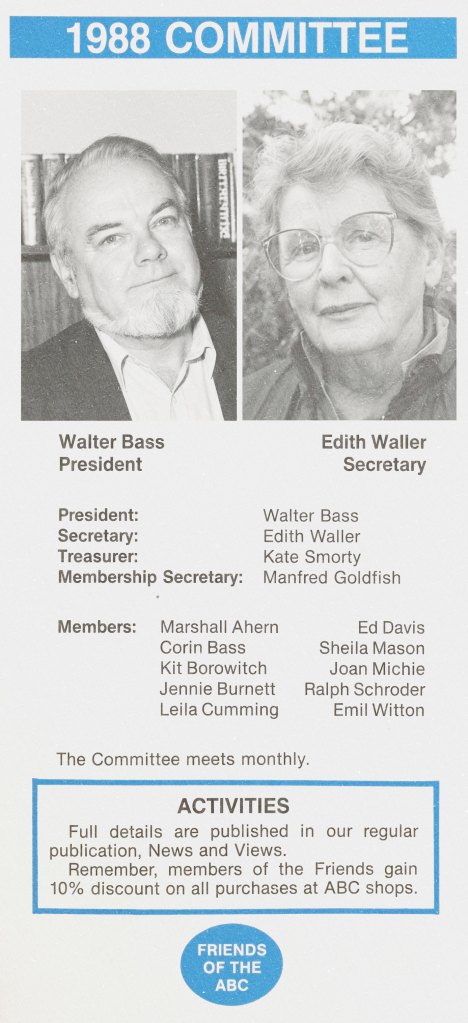
Edith Waller

Edith Waller was a key figure in the NSW Friends of the ABC in the 1980s and 1990s. She joined the committee in 1981 and quickly became secretary. In her report to the Annual General Meeting in 1986, she affirmed the potential of Friends of the ABC:

I would like to stress, it is not impossible for articulate minorities to gain the ear of governments if they are vocal enough and persistent enough… we are not powerless.

The 1988 Friends of the ABC committee, including Walter Bass and Edith Waller. ABC Friends Archives.

Edith Waller became editor of the newsletter News & Views, which blossomed under her direction. Her daughter Ruth Waller remembers her mother’s commitment to the Friends of the ABC.

Edith Waller also wrote to the ABC, both to staff and management. She would congratulate producers for programs she admired, and politely let management know about decisions of which she was critical. Her correspondence to the ABC, with the replies she received, as well as her letters to newspapers and articles for News & Views, were placed at the National Library of Australia at the instigation of historian Ken Inglis.

Edith Waller served on the NSW State Advisory Council for many years. She was made an honorary Life Member of the NSW Friends of the ABC in 1994.

Edith Waller, photo supplied.

‘Eight Cents a Day’ campaign

ABC Television, February 1988, Australian Broadcasting Corporation Library Sales.

In October 1986, David Hill was appointed ABC Managing Director. In the face of continued cuts to ABC funding, Hill decided to confront the government head-on. In late 1987, the campaign known as ‘Eight cents a day’ was launched by the ABC to demonstrate its value to Australians. Promotions on radio and television showed audiences what they were getting ‘for only 8 cents a day’.

In addition to on-air promotions, the ABC’s Corporate Affairs division distributed 100,000 copies of a leaflet called ‘Time for Action’. This called on the public to support improved funding for the ABC and suggested ways individuals could put pressure on the government to do so, including holding public meetings.

Time for Action campaign leaflet. ABC Archive.

Future of the ABC, February 1988

ABC Sydney, 7pm News, 26 February 1988, Australian Broadcasting Corporation Library Sales.

Sydney Rally 1988

On the morning of 24 February 1988, The Sydney Morning Herald published a letter from Walter Bass of the Friends of the ABC. He identified an attack on the ABC from two fronts – funding cuts and a proposal from Labor Senator Gareth Evans that ABC programs be categorised as ‘charter’ or ‘non-charter’.

The Friends of the ABC and the ABC’s NSW National Advisory Council joined together to host the rally at the Sydney Town Hall. The audience of over 3,000 heard ABC Managing Director David Hill speak under a banner saying ‘Australia’s backing the ABC’.

Also on the platform was president of NSW Friends of the ABC, Ed Davis, only recently in the position. He was a professor of economics at Macquarie University, often speaking on the ABC on economic matters and industrial relations.  He recalls the excitement of this occasion.

Ed Davis, photo supplied.

The Sydney Morning Herald reported the event the following day with a photo of queues making their way into the Town Hall. 

The Friends of the ABC planning meetings were on a smaller scale – but nevertheless, could encompass different views. Ed Davis resigned as NSW president in the early 1990s as his family and work commitments grew; in addition, differences emerged between him and others on the committee.

The members of ABC Friends are not all cut from the same cloth. There is a range of views about the relationship between ABC Friends and the ABC, particularly the role of ‘critical friend’. 

Ed Davis returned to active participation in the Friends almost 20 years later and again, took a leading role with ABC Friends.

Ed Davis and Ita Buttrose. Photo supplied.

Melbourne Town Hall rally, March 1988

The newly formed Victorian Friends of the ABC was out in force on the evening of 7 March 1988. The Melbourne Symphony Orchestra opened the evening before a succession of speakers spoke on two issues: firstly, to support increased funding for the ABC, and secondly to voice their opposition to a proposal by Senator Gareth Evans to restrict public funding to ‘core’ ABC programs. The other ‘non-core’ output – including sport, religion and lifestyle – was to be funded by sponsorship.

The audience at the Melbourne Town Hall cheered the new President of the Friends of the ABC Victoria, former Liberal Premier, Sir Rupert Hamer. He was a judicious choice of president, and the event was covered on the ABC’s television news that evening.

ABC Melbourne, Late News, 7 March 1988, Australian Broadcasting Corporation Library Sales.

Melbournian Terri MacKenzie was in the audience that evening. By the time it finished, she was ready to sign up.

Like many members of Friends of the ABC, Terri MacKenzie had a long association with the ABC as an audience member.

Terri MacKenzie, ABC Friends Archives.

Survival concert

The ‘Survival Concert’ hosted jointly by Friends of the ABC and the Public Sector Union on 26 May 1991, had a cheering audience of 2,000 people. The speakers included Jim Dibble, Quentin Dempster, Noni Hazelhurst, H. G. Nelson and Karina Kelly, interspersed with performances from Don Burrows, the Conservatorium Orchestra and an emerging attraction, Pacemaker and the Jerries. Sound, lighting and direction were handled by off-duty ABC staff.

News & Views published an appreciative letter from Senator Cheryl Kernot afterwards.

I am writing to tell you how much my family and I enjoyed yesterday’s absolutely wonderful concert. Thank you for giving me the opportunity to speak. I regard it as a privilege to publicly demonstrate my commitment to the ABC.

(News & Views, Vol 5, no 7, Winter 1991, p. 3)

The ABC’s various unions were active across the 1970s and 1980s in raising public awareness of threats to the ABC. They partnered with the Friends of the ABC to co-host several events. On other occasions, a Friends representative might appear as a speaker, for instance Sir Rupert Hamer, the new president of Friends of the ABC in Victoria, spoke in August 1988 at The Big Gag, a concert organised by the Public Sector Union at the Melbourne Town Hall.

The Big Gag, ABC Archives, supplied by PSU.

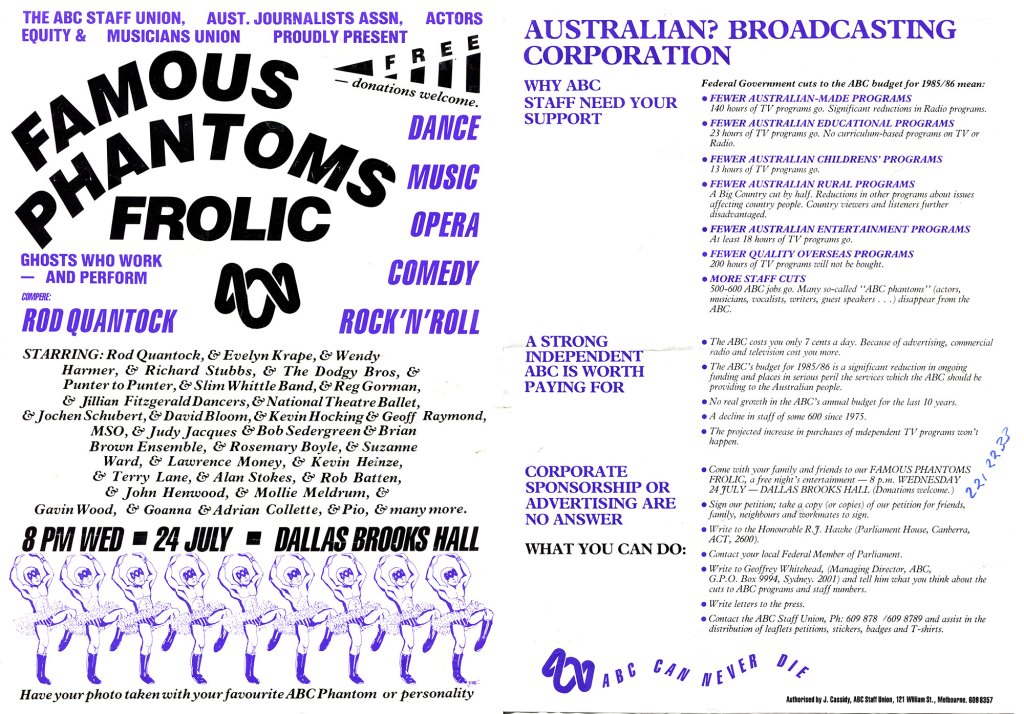
Staff in different divisions of the ABC could be represented by different unions. Four of these came together to hold the Famous Phantoms Frolic in July 1985. The title derived from the expression coined by then ABC Managing Director Geoffrey Whitehead to refer to the ABC’s part-time and casual staff as a ‘phantom army’.

Famous Phantoms Frolic program. ABC Friends Archives.

Walter Bass

Walter Bass was one of the co-founders of Friends of the ABC in 1976 and he went on to become its principal spokesperson in the 1980s and early 1990s. He was an avid letter writer and frequently quoted in press articles. He gave interviews to ABC radio and appeared on television, including Lateline in 1992.

The ABC’s funding was the issue in this instance, particularly in connection with the proposal that it participate in ‘pay tv’. The Board proposed two ABC subscription channels, but many people were concerned this would pave the way for the end of free-to-air television for everyone. Walter Bass was aware of the effects a similar move had had in New Zealand.

Lateline, 26 August 1992, Australian Broadcasting Corporation Library Sales.

Walter Bass and fellow Friend of the ABC Paul Bales stood as candidates for the senate in the federal election in March 1993. Corin Fairburn Bass remembers the time well.

Walter Bass talked at the time about why he chose to participate in the election:

I’m trying to put a bit back into the organisation I’ve loved all my life. It’s not just a sentimental attachment – it’s my deep conviction that the ABC is an essential part of the democratic process in this country.

(News & Views, vol 6, no. 3, 1992, p. 1)

Walter Bass retired from Friends of the ABC in 1996.

Walter Bass. Photo supplied.

Reflection: Newsletters

Newsletters have had a crucial role in keeping ABC Friends afloat since its inception.  They have been key to mobilising members, alerting them to campaigns and actions in which they can participate.

Newsletters inform members of government policy relating to the ABC, of developments in the ABC itself, and of changes in the broader media field. Newsletters also serve to circulate ideas about how to advocate, as well as celebrating the achievements of branches.

Aunty’s Nieces and Nephews began a newsletter within weeks of its first meeting – it had an informal air and was written in the style of a letter between friends. Friends of the ABC in Sydney started a newsletter in 1977 with the election of a new president, Joyce Belfrage (a former ABC TV producer notorious for having thrown a typewriter out of her office window, she was later one of the first media academics in Australia).

By 1980, the NSW branch was producing a thrice-yearly newsletter called News & Views. The final issue of Aunty’s Nieces and Nephews newsletter was in 1985. Newsletters in other states also ceased during the 1980s. But NSW’s News & Views was distributed interstate. It was also dispatched to the ABC, its advisory councils and unions – and retained in their archives. It contributed to the circulation of ideas and the formation of a network of individuals across Australia with shared concerns regarding advocacy for the ABC.

From the mid 1990s, there was a proliferation of newsletters within Friends of the ABC – dispatched by volunteers who would fold and apply address labels. The Victorian branch underwent rapid growth and began the production of Backchat in early 1997. It was succeeded in 2000 by Vic News, which was initially a supplement to Background Briefing, which began in 1999 as a national newsletter produced in Adelaide by editor Joan Laing. In 2006, Background Briefing ceased and Victoria began News & Views (the name had become available when in 2000, NSW renamed their newsletter Update). News & Views (Victoria) was edited by Campaign Manager Glenys Stradijot until its final issue in 2015.

Update was in production until the end of 2023. It became a substantial publication of up to 32 pages, under the stewardship of editor Mal Hewitt, deputy editor Diana Wyndham, and variously production managers Chris. Cartledge and Angela Williamson.

Mal Hewitt was disappointed by the decision to cease the hard copy production of Update in 2023:

When you’re in the community, at a local street stall talking to somebody, you can say, hey, take a copy of Update, take it home, and put it on your bedside and you can read all about it. You can’t do that with a digital statement.

In 2015, Victoria started email news. ABC Friends e-news is currently produced nationally, with additional e-newsletters in NSW and Victoria. Social media has also made an abundance of information available, with short reels and posts linking to videos of complete panel discussions.

The copy for newsletters could be written by the editorial team and other Friends members, but frequently included articles by academics, journalists and ABC staff – often the talks of visiting speakers would be published. Mal Hewitt has described Update as a link with the ABC, featuring interviews and profiles of ABC staff.

Many cartoonists gave permission for their published work to be reprinted in newsletters. Ron Tandberg and Phil Somerville were particularly generous in this regard.

Andrews, Kylie Trailblazing Women of Australian Public Broadcasting, 1945–1975, Anthem Press, London, 2022.

Bandler, Hans ‘Mass Communication for the Younger Generation’, Quockerwodgers: Mass Media Control, Australian Mass Communications Council, Sydney, 1973, pp. 35–37.

Berg, Chris and Sinclair Davidson, Against Public Broadcasting, Connor Court, 2018.

Bongiorno, Frank Dreamers and Schemers: A Political History of Australia, La Trobe University Press, Melbourne, 2022.

Dempster, Quentin, Death Struggle, Allen & Unwin, 2000.

Inglis, K.S., This is the ABC: The Australian Broadcasting Commission, 1932–1983, 2nd ed, Black Inc., Melbourne, 2006.

Inglis, K.S., Whose ABC? The Australian Broadcasting Commission, 1983–2006, Black Inc., Melbourne, 2006.

Ganter, Sarah Anne,Christian Herzog and Viola Candice Milton, ‘Public Service Broadcasting-Friends groups as a microcosm of public interest media advocacy’, Humanities & Social Science Communications, vol. 7, no. 68, 2020.

Griffen-Foley, Bridget ‘Chronically Concerned’: The Australian Broadcasting Commission and its Advisory Committees’, Media History, Vol. 31, No. 3, 2025, pp. 279–310.

Harding, Richard Outside Interference: The Politics of Australian Broadcasting, Sun Books, Melbourne, 1979.

Holmes, Jonathan, On Aunty, Hachette Australia, 2019.

Iveson, Kurt, ‘Building a City For “The People”: The Politics of Alliance-Building in the Sydney Green Ban Movement’, Antipode, vol. 46, no. 4, 2014.

Molomby, Tom, Is There a Moderate on the Roof?: ABC Years, W. Heinemann Australia, Port Melbourne, 1991.

Lawrence, Mark, ‘How ABC acquired an abundance of nieces and nephews’, The Age, Green Guide,23 November 1978, p. 2.

Napoli, Philip M., ‘Public Interest Media Advocacy and Activism as a Social Movement’, Annals of the International Communication Association, vol. 33, no. 1, 2009, pp. 385–429.

Newspapers: The Age, The Sydney Morning Herald, Canberra Times

National Archives of Australia

Paul, Meg, ‘Public Pressure Groups in Broadcasting’, in Brendan O’Dwyer (ed.), Broadcasting in Australia: Today’s Issues and the Future. Proceedings of the National Conference held in July 1980, Centre for Continuing Education, Australian National University, Canberra, 1980, pp. 137–43.

Ricketson, Matthew & Patrick Mullins, Who needs the ABC, Scribe, 2022.

Stephens, Tony, ‘Bandler, Ida Lessing Faith (1918–2015)’, Obituaries Australia, National Centre of Biography, Australian National University, https://oa.anu.edu.au/obituary/bandler-ida-lessing-faith-15982/text30791, accessed 16 January 2026.

Stephens, Tony ‘Bandler, Hans (1914–2009)’, Obituaries Australia, National Centre of Biography, Australian National University, https://oa.anu.edu.au/obituary/bandler-hans-19329/text30793, accessed 16 January 2026.

August 1996: rallying season

Rallies have traditionally given the public a chance to declare their support for a cause: a slew of rallies took place in August 1996 to let ABC supporters do precisely that.

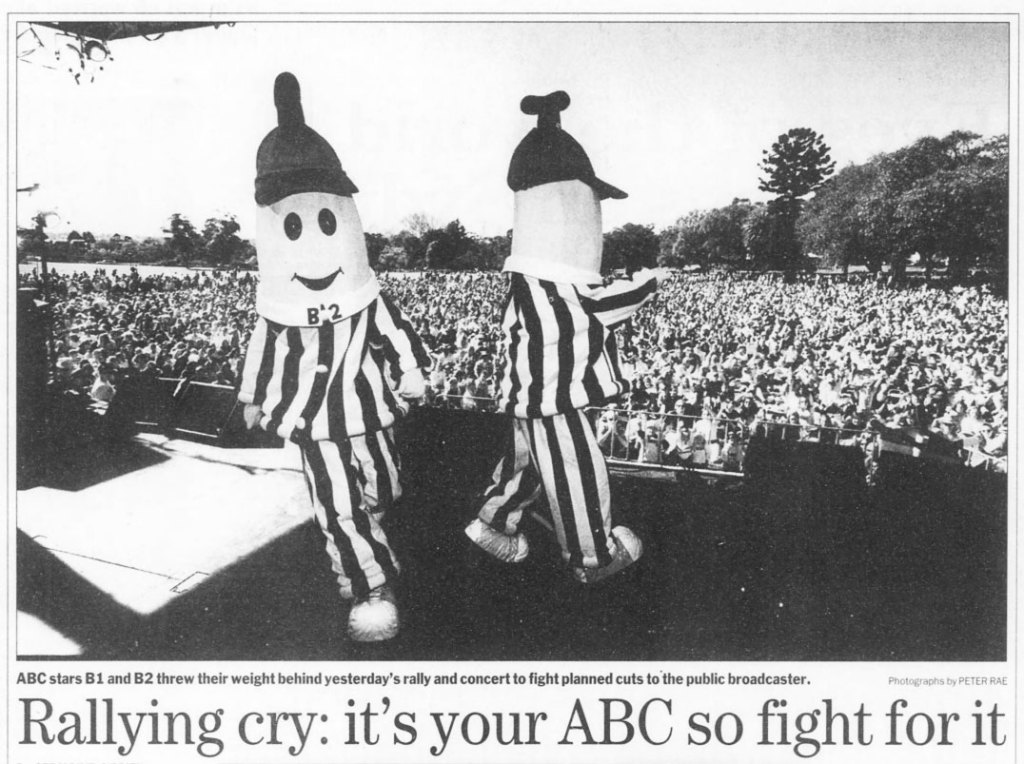
The first, at The Domain in Sydney on 4 August, was organised by ABC staff – journalists Maxine McHugh and Quentin Dempster shared the stage with Jemima from Play School and the Bananas in Pyjamas, before Christine Anu, Roy and H.G. and the Sydney Symphony Orchestra among others entertained an estimated crowd of 60,000.

A stall run by NSW Friends of the ABC enabled 4,000 letters to be written by members of the public to politicians. Among the many speakers was magistrate Pat O’Shane, who took issue with Bob Mansfield saying he did not want the inquiry he was then chairing into the ABC to become ‘emotional’. Pat O’Shane’s response was to declare ‘we are entitled to be emotional about the things we care about and if he can’t stand our emotional heat, he should get out of the kitchen cabinet.’

ABC rally at The Domain, Sydney, The Sydney Morning Herald, 5 August 1996, p. 3.

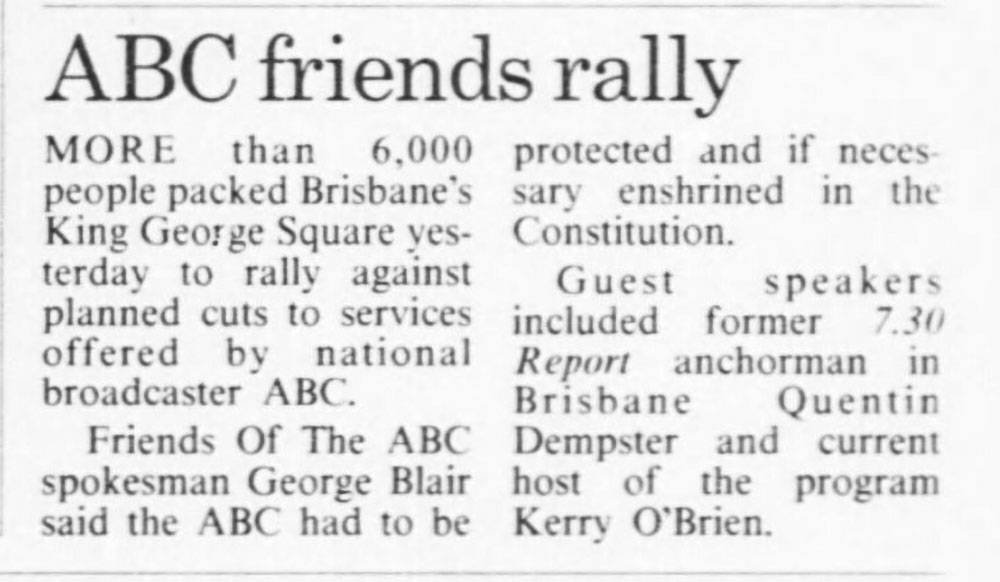
Rallies continued across Australia. Friends of the ABC in Queensland spokesman George Blair spoke at an event in Brisbane on 10 August calling for ‘protection’ of the ABC.

The Herald Sun, 11 August 1996, p. 14.

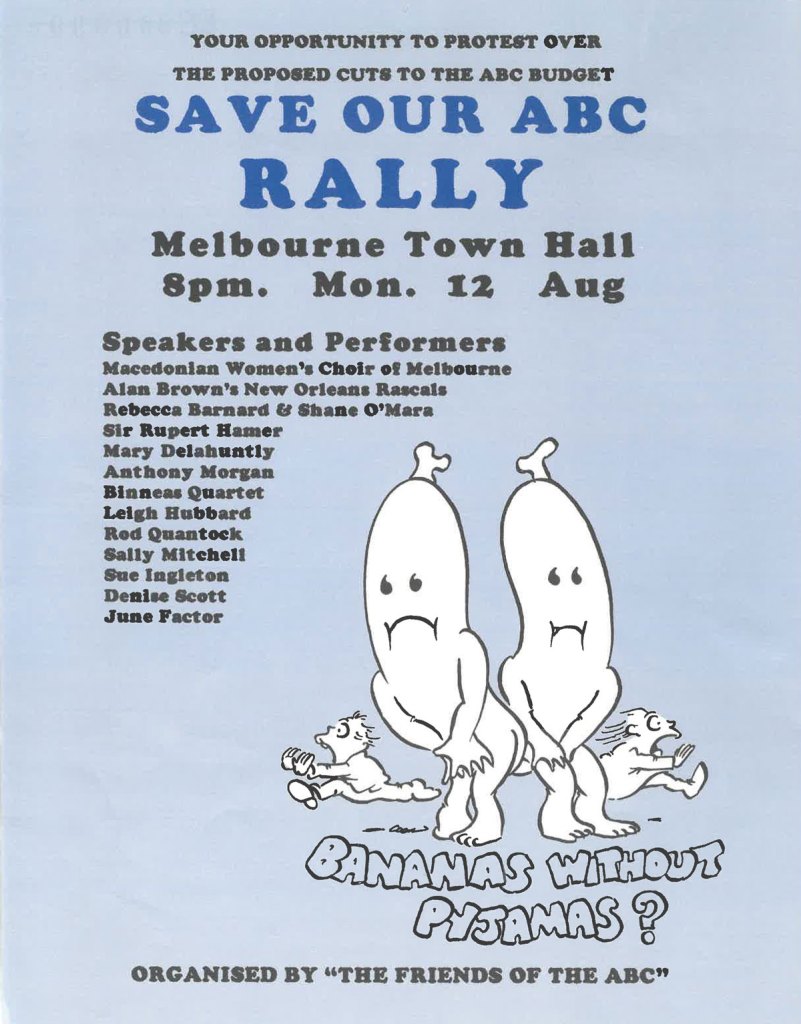
While in Melbourne, the City Council provided the Melbourne Town Hall for a rally and concert on 12 August organised by Friends of the ABC.

Flyer promoting the rally. ABC Friends Archives.

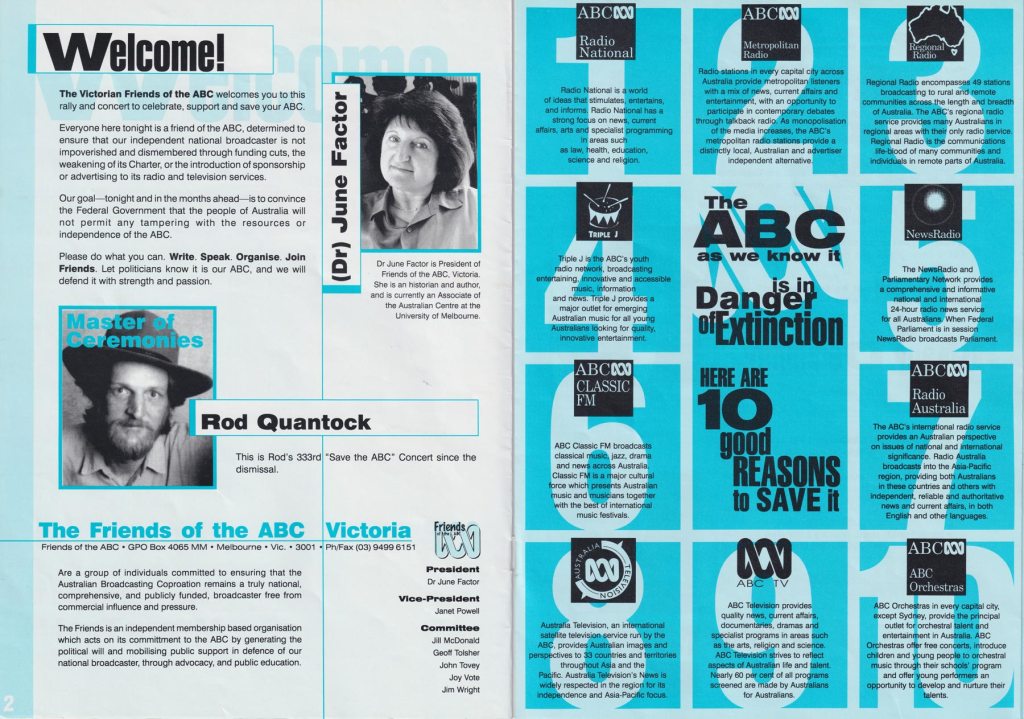
June Factor’s committee produced a stylish program for the occasion. It was almost a manifesto, with statements affirming the value of the ABC from groups such as the Council on the Ageing Victoria and the Victorian Council for Civil Liberties, as well as listing ’10 good reasons’ to save the ABC.

Save Our ABC rally program, 12 August 1996. ABC Friends Archives.

Glenys Stradijot, then a Friends of the ABC Victoria volunteer and later employed as campaign director, remembers the part the ABC itself played in the Melbourne rally.

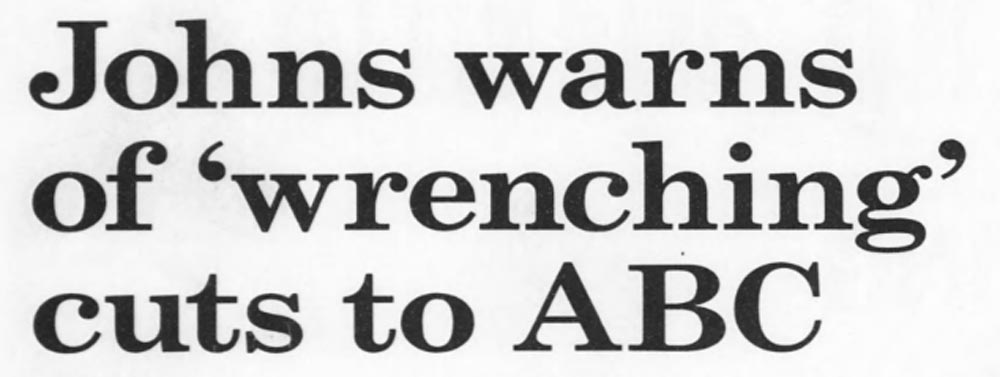
In September, ABC Managing Director Brian Johns addressed a Friends of the ABC rally in Adelaide, describing the proposed cuts as ‘not a pruning exercise, but wrenching’ in their impact. He made a point of referring to ‘the public outcry’ shown by the rallies.

The Sydney Morning Herald, 9 September 1996, p. 2.
Loading Comments...